
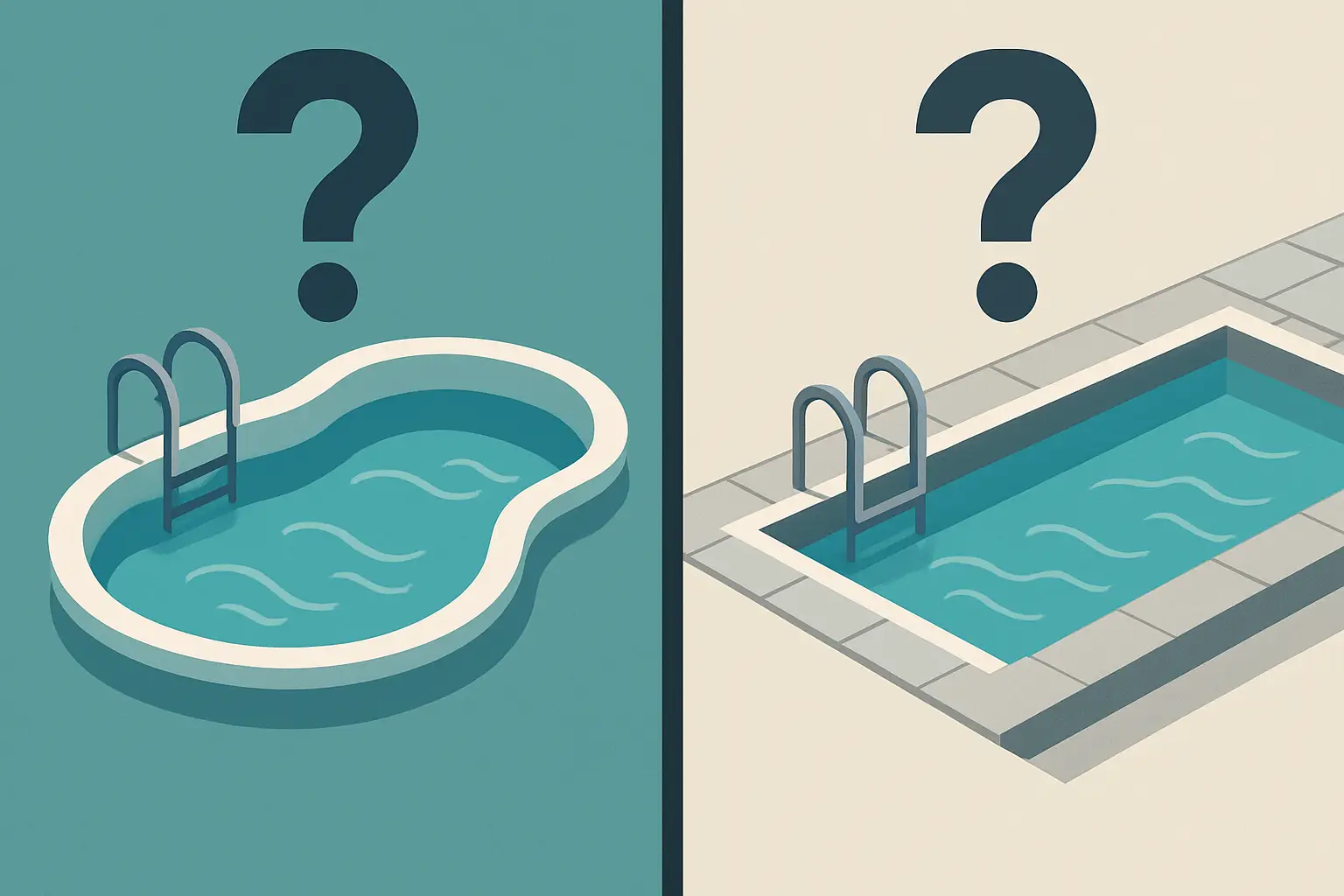
If you want a pool because you want to use it – not because you want a second job – the material choice matters more than most homeowners expect. “Fiberglass vs concrete pool” sounds like a simple comparison, but it’s really a decision about how you want your backyard to feel day to day: the build timeline, the waterline look, the surface under your feet, the maintenance habits you’ll live with, and how much design freedom you actually need.
This is the clean way to think about it: fiberglass is a manufactured shell installed into an excavation, and concrete is a custom-built structure formed on site. Both can be beautiful. Both can raise the value and livability of a home. They just ask different things from the homeowner over the life of the pool.
Fiberglass vs concrete pool: the real differences
Concrete gets most of its strength and identity from being built in place. Rebar goes in, plumbing and fittings are set, and the shell is created by applying concrete (often shotcrete) to form the pool. You can shape it to the property, add details, and build to spec.
Fiberglass is different. The pool arrives as a finished shell with steps, benches, and contours molded in. It’s set into the hole, leveled, plumbed, and backfilled. Because it’s a factory product, the surface is consistent and smooth right away.
That “built on site” versus “delivered as a shell” distinction explains most of what follows: speed, cost predictability, long-term surface care, and how much customization you can realistically use.
Timeline: how soon you’re swimming
If your goal is to be swimming this season, fiberglass is usually the faster path. The main steps are excavation, base prep, shell set, plumbing, backfill, and deck work. Once the shell is in and the system is running, you’re much closer to usable water.
Concrete builds are a longer relationship with the calendar. The structure has multiple phases, and you’re working with on-site forming, curing time, and finish work that can stretch the schedule. Weather can influence pacing more, and coordination has more moving parts.
The practical takeaway: if speed and schedule certainty are high priorities, fiberglass often wins. If your project is tied to a larger backyard renovation or you’re planning for a specific custom layout, the concrete timeline may still be worth it.
Design freedom: what “custom” actually buys you
Concrete is the option when you want true freedom. Tight side yards, unusual angles, a specific deep-end dimension, a full-width tanning ledge, a perimeter overflow look, an integrated spa with exact proportions – concrete can do those things because it’s built to your plan.
Fiberglass has plenty of attractive shapes, but it does not pretend to be limitless. You choose from a range of sizes and styles. That can be a benefit, not a drawback, if you want decisions simplified and you prefer a clean, proven layout with built-in seating and steps.
A good way to decide is to look at your “must-haves.” If you’re chasing one very specific geometry to fit the property or to match an architectural vision, concrete earns its keep. If your must-haves are more about comfort and usability (steps you like, a bench for conversation, a clean rectangle for laps), fiberglass can check those boxes without the complexity.
Surface feel and everyday comfort
The pool surface is where you’ll feel the difference every weekend.
Fiberglass is known for a smooth finish. That matters if you have kids who will spend hours on the steps, or you want a pool that feels easy on skin. It also tends to be less inviting to algae compared to more porous surfaces, which affects cleaning effort.
Concrete surfaces vary by finish. Some finishes are smoother than others, and some are intentionally textured. Over time, certain concrete surfaces can become rougher, and that can show up as scrapes on knees and toes, especially on steps and ledges where people linger.
If “resort-comfort” is your north star, fiberglass starts with an advantage. Concrete can be comfortable too, but the finish choice and long-term upkeep have more influence on how it feels year after year.
Maintenance and water chemistry: the long game
Homeowners rarely regret their pool because of the first month. They regret it because of the fifth year.
Fiberglass is non-porous, which generally helps with algae resistance and makes brushing easier. That can translate to less chemical swing and less time spent fighting the pool when you miss a day or two. It does not mean “no maintenance.” It means the surface is working with you, not against you.
Concrete is more demanding over time because it’s more porous. That porosity can make it easier for algae to hold on, especially if chemistry drifts and sanitation dips. Many concrete owners brush more often and pay closer attention to balancing to avoid scale, staining, and surface issues.
If you travel, work long hours, or simply want a pool that’s forgiving, fiberglass is usually the calmer ownership experience. If you like hands-on control and you’re committed to consistent care, concrete can be perfectly manageable.
Durability: what holds up, and how it fails
Both materials can last for decades when installed well and cared for. The difference is in how they age and what “repair” looks like.
Concrete is structurally strong and can be resurfaced. That’s a big point in its favor. The trade-off is that resurfacing is not optional forever. Most concrete pools eventually need a new interior finish, and that’s a real project with real cost and downtime.
Fiberglass shells can develop cosmetic issues like gelcoat fading or surface wear over a long timeline, and they can be repaired. The shell itself is flexible, which can be an advantage in certain soil conditions, but the quality of installation matters a lot. Leveling, base prep, and backfill are not corners you want anyone cutting.
Here’s the honest version: neither option is “set it and forget it.” Concrete expects periodic interior renewal. Fiberglass expects correct installation and reasonable surface care so it stays looking like the day you fell in love with it.
Cost: predictability vs open-ended choices
Pricing varies by region, access, excavation complexity, decking scope, and equipment package, so any blanket number you see online should be treated as a range, not a quote.
Fiberglass often has more predictability because the shell is a defined product. You’ll still have variables – cranes, access, excavation, rock, water table, electrical, decking – but the core vessel is not being invented in your yard.
Concrete can start with a base scope and then expand as design details get added: special shapes, upgraded finishes, integrated spas, water features, and complex decking transitions. That’s part of what makes it appealing, but it’s also where budgets can stretch.
The best mindset is to set a comfort range and decide whether you want to spend your budget on custom structure or on the total backyard experience (decking, shade, lighting, and the features you’ll use every day).
Climate, soil, and site constraints
Your yard matters as much as your taste.
If access is tight, a fiberglass delivery and set may be challenging depending on the route and crane placement. Concrete can sometimes be more adaptable to difficult access because materials come in smaller loads, even though the build is longer.
Soil conditions and drainage also play a role. Both pool types can succeed in challenging sites when engineered and installed correctly, but neither should be approached casually if you have a high water table, poor drainage, or expansive soils. This is where local experience is worth more than opinions.
Which pool fits which homeowner?
Most homeowners don’t need a perfect answer. They need the right answer for their habits.
Choose fiberglass when you want a faster path to swimming, a smooth surface, and a lower-friction maintenance routine. It fits homeowners who value comfort and consistency and would rather spend time enjoying the pool than managing it.
Choose concrete when you want a truly custom layout or you have a specific design that a pre-molded shell can’t match. It fits homeowners who care deeply about bespoke aesthetics, exact dimensions, and are prepared for the maintenance rhythm and eventual resurfacing that comes with that freedom.
If you’re torn, ask yourself one direct question: are you buying a pool for the design, or for the lifestyle? Either answer is fine. It just points to a different material.
A clean way to decide without overthinking it
Start with three facts about your property: access, yard shape, and drainage. Then be honest about your schedule and patience for weekly care. Finally, decide what you want the pool to feel like: soft and simple, or custom and architectural.
If you want a conversation that stays practical and tied to your yard, Coastal Cove Pools can walk you through options and what ownership actually looks like over time at https://coastalcovepools.com.
The best pool is the one that gets used on random Tuesdays, not just on holidays – pick the material that makes that easy for you.