
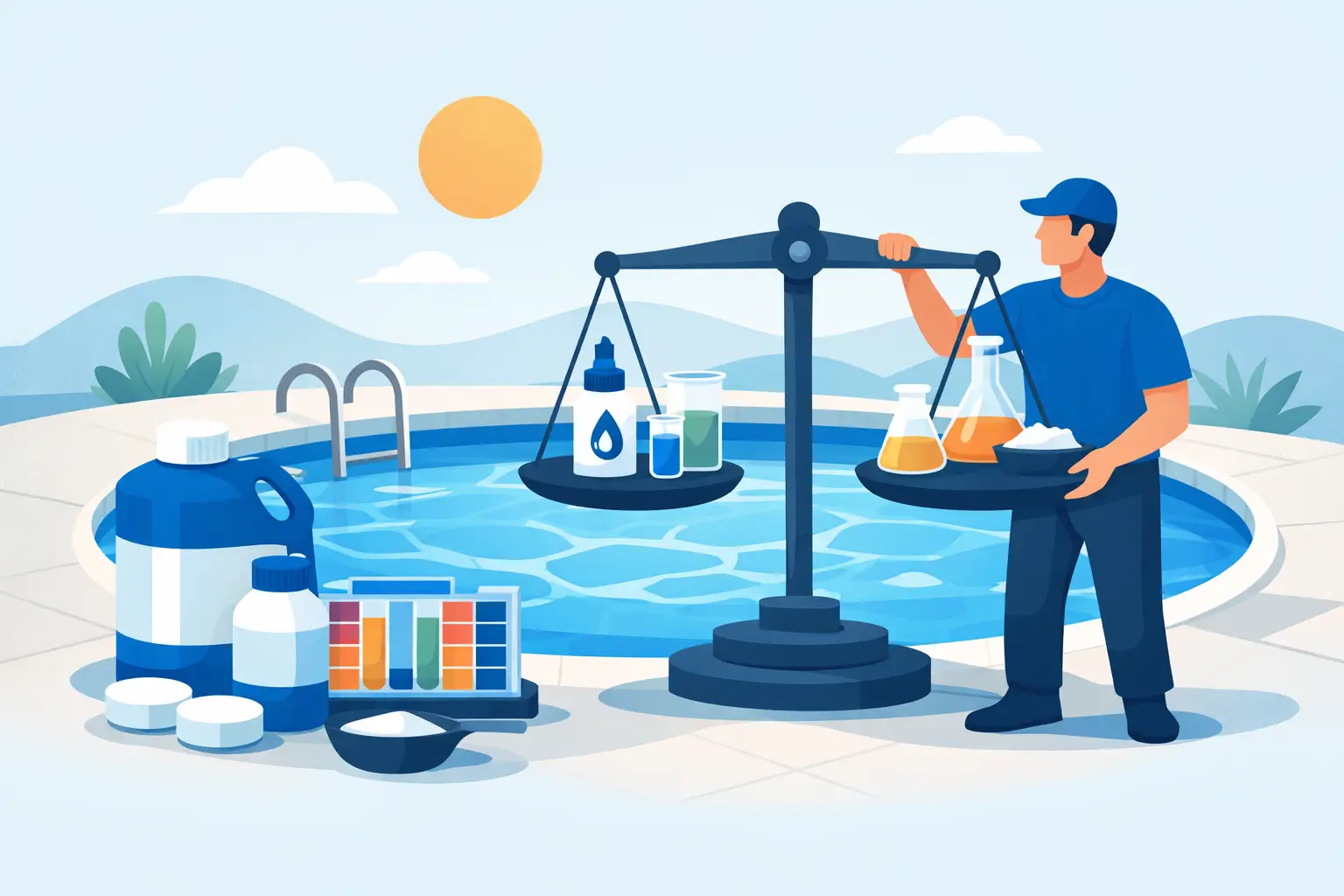
Clear water can still be off.
That is what catches a lot of pool owners by surprise. The pool looks fine, the surface is bright, and then a test strip says the chemistry is drifting. If you are learning how to balance pool chemicals, appearance alone is not enough. Good pool water is measured, adjusted in the right order, and maintained with consistency.
For homeowners, this is less about chasing perfect numbers every day and more about protecting the pool, the equipment, and the experience. Balanced water feels better, sanitizes better, and helps you avoid the expensive side of pool ownership – scale, corrosion, cloudy water, algae, and shortened equipment life.
How to balance pool chemicals in the right order
The biggest mistake is adjusting everything at once. Pool chemistry works as a system, so one change can affect another. The cleanest approach is to test first, then correct in order.
Start with total alkalinity, then pH, then calcium hardness, then stabilizer if needed, and finally sanitizer. That order matters because alkalinity acts like a buffer for pH. If alkalinity is too low or too high, pH tends to swing or resist correction. Once those two are in a reasonable range, the rest becomes easier to manage.
For most residential pools, these are the common target ranges:
- Total alkalinity: 80-120 ppm
- pH: 7.2-7.6
- Chlorine: 1-3 ppm for routine sanitation
- Calcium hardness: 200-400 ppm, depending on surface type
- Cyanuric acid: 30-50 ppm for many outdoor pools, sometimes higher in strong sun climates
Those numbers are not one-size-fits-all. A plaster pool, for example, has different calcium needs than a vinyl liner pool. Saltwater pools also have their own operating range for salt and often slightly different practical chlorine behavior. The point is not to memorize every variation. The point is to test against the needs of your specific pool.
Test before you treat
A reliable test kit gives you a much better read than a quick glance or guesswork. Test strips are convenient and useful for routine checks, but a liquid drop kit is usually more dependable when the water is off and you need to make a correction with confidence.
Test the water at least once a week in the swim season, and more often during heavy use, extreme heat, or after a storm. If you just added fresh water, hosted a weekend of pool traffic, or had a spell of intense sun, chemistry can move faster than expected.
Take the sample from elbow depth, not right at the surface, and away from return jets. That gives you a truer reading of the pool rather than the water most recently pushed through the system.
Adjust total alkalinity first
If total alkalinity is low, pH can swing quickly and make the water harder to manage. Low alkalinity can also make water more aggressive, which is tough on plaster, metal components, and equipment over time. To raise it, pool owners typically use sodium bicarbonate.
If total alkalinity is too high, the pool may hold a stubbornly high pH, and scaling becomes more likely. Lowering alkalinity usually involves adding acid carefully over time, then circulating and retesting. This is one of those areas where patience matters. Big chemical dumps create bigger problems.
Bring pH into range
Once alkalinity is close, adjust pH. If pH is too low, the water can irritate skin and eyes and slowly damage pool surfaces and equipment. If it is too high, chlorine becomes less effective, and the water is more likely to cloud or leave scale behind.
To raise pH, pool owners commonly use soda ash. To lower it, muriatic acid or sodium bisulfate is often used. Muriatic acid works well, but it needs careful handling and storage. Add chemicals exactly as labeled, with the pump running, and give the water time to circulate before testing again.
Check calcium hardness
Calcium hardness matters more than many homeowners realize. Water with too little calcium can pull minerals from plaster and grout, which is not something you want from a long-term finish standpoint. Water with too much calcium can leave scale on tile, heaters, salt cells, and other equipment.
If hardness is low, calcium chloride is commonly used to raise it. If it is high, the solution is less convenient. Usually that means dilution with fresh water or more advanced water management, especially in regions where fill water already has a high mineral content. This is one reason chemistry can feel harder in some markets than others. Local water conditions matter.
Add or adjust stabilizer carefully
Cyanuric acid, often called stabilizer or conditioner, helps protect chlorine from being burned off by sunlight. In an outdoor pool, too little stabilizer can make chlorine disappear quickly on hot, bright days. Too much stabilizer, though, can reduce chlorine’s practical effectiveness and make cleanup after problems much harder.
This is a common trade-off in residential pools. Homeowners want chlorine to last, but overusing stabilized tablets or adding extra stabilizer without testing can push levels too high. If cyanuric acid is elevated, the fix often involves partial draining and refilling. It is easier to prevent that problem than undo it.
Finish with sanitizer
Once the water is balanced, adjust chlorine to the proper level. Chlorine is what keeps the water safe, but it performs best when pH and stabilizer are already where they should be. If you add chlorine to poorly balanced water, you can spend more and get worse results.
Liquid chlorine, tablets, granular products, and salt chlorine generators all get used in residential pools, but they do not behave exactly the same way. Tablets are convenient but can add stabilizer over time. Liquid chlorine adds no stabilizer but needs regular dosing. Salt systems create chlorine continuously, though the water still needs full chemical balance.
Why pool water gets out of balance
Even a well-maintained pool drifts. Sun burns off sanitizer. Rain can dilute chemistry. Swimmers bring in sunscreen, body oils, and debris. Heat changes demand. Leaves and pollen add organics. Fresh fill water can raise calcium or shift alkalinity depending on your local supply.
That means balancing is not a one-time event. It is ongoing correction based on conditions. The best routine is steady and simple: test, adjust one issue at a time, circulate, and retest before adding something else.
Trying to force the water back in one afternoon usually backfires. If the pool is badly off, expect it to take a little time.
How to balance pool chemicals without overcorrecting
Overcorrection is where many expensive mistakes happen. A pool owner sees low chlorine and high pH, adds several products back to back, and then ends up with cloudy water, a pH swing, or chemical waste. More is not better.
Use measured doses based on your pool volume. Follow label instructions. Let the pump run long enough to distribute the chemical. Retest before making another major change. And unless the product label specifically allows it, do not mix chemicals together.
It also helps to know when not to chase a number. A pH of 7.6 does not need a dramatic response just because it is not 7.4. A small drift inside an acceptable range is different from a chemistry problem.
When to shock the pool
Shocking is useful, but it is not a cure for everything. It is best used after heavy swimmer load, visible contamination, algae risk, or combined chlorine issues. If the pool smells strongly of chlorine, that can actually mean it needs oxidation, not less chlorine.
Still, shock works best when the basics are already in place. If pH is high, shock is less effective. If stabilizer is excessive, shock demand can become frustratingly high. That is why balanced water is the foundation, not an extra step.
Seasonal shifts matter
Summer pools usually need more frequent testing because heat, sunlight, and use all increase demand. In spring, pollen and rain can throw things off. After a storm, the pool may look normal but still need attention. In fall, cooler temperatures may slow chlorine consumption, but debris can create a different kind of chemistry load.
Opening and closing season are also when hidden imbalances show up. Water that was mostly manageable during routine use can become a problem when circulation patterns, temperature, and sanitizer demand change.
For homeowners who want a backyard pool to feel easy, the goal is not to become a chemist. It is to understand the order of operations, avoid guesswork, and stay ahead of problems while they are still small.
A balanced pool is not just cleaner on paper. It feels better to swim in, looks better in the yard, and puts less stress on the finish and equipment that make the whole space work. If the water has been giving you mixed signals, slow down, test accurately, and correct one step at a time. That steady approach is what keeps a pool ready for the kind of afternoons it was built for.