
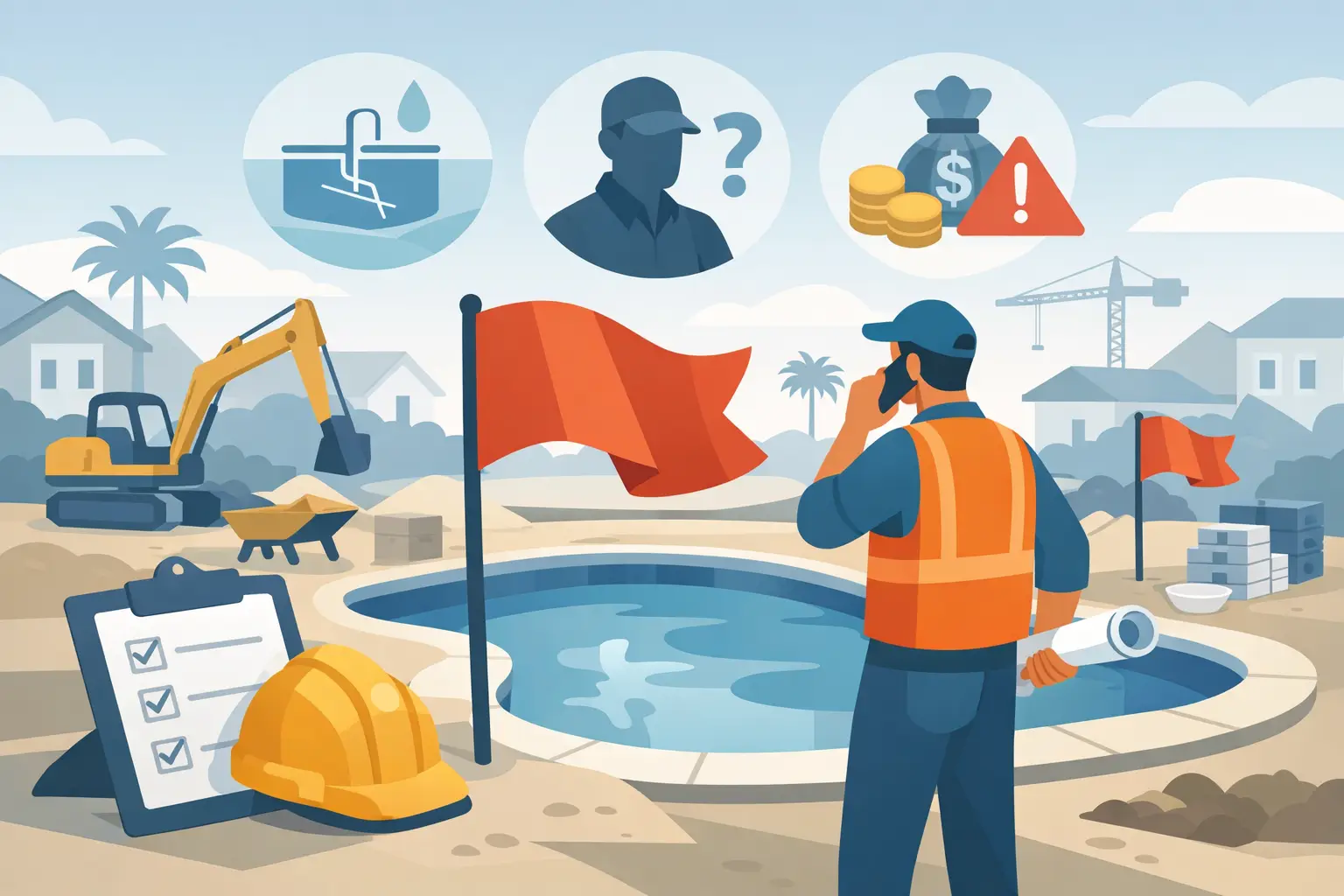
A pool should feel like an upgrade to your home, not the start of a long dispute. Most homeowners do not hire pool builders often, which makes it easy to miss early warning signs. That is why knowing the real pool contractor red flags matters before you sign a contract, hand over a deposit, or let work begin in your backyard.
The hard part is that some warning signs do not look dramatic at first. A contractor may seem friendly, responsive, and eager to start. The problems usually show up in the details – the paperwork, the scheduling, the way questions are answered, and what gets left vague.
Why pool contractor red flags show up early
Pool projects are part design, part construction, and part long-term equipment planning. When a contractor is disorganized, underqualified, or overselling, that usually appears long before excavation day. It shows up in the estimate that feels rushed, the permit conversation that stays fuzzy, or the promise that everything will be done “fast” without much explanation.
For homeowners, that matters because a pool is not a small cosmetic job. It affects your property, your budget, your yard, your timeline, and your future maintenance costs. A poor contractor can leave you with drainage issues, equipment problems, finish defects, or a project that stalls halfway through summer.
1. The bid is much lower than everyone else
A low number gets attention. It also deserves scrutiny.
If one quote comes in far below the others, there is usually a reason. Sometimes the contractor left out real costs and plans to charge change orders later. Sometimes cheaper equipment is being swapped in without much discussion. In other cases, supervision, site prep, drainage, decking, or startup service has been minimized to make the price look better.
Lower pricing is not automatically wrong. A local company with efficient crews or simpler overhead may be competitive. But if the gap is large, ask exactly what is included, what brand and model equipment is specified, who handles permits, and what happens if site conditions change.
2. The contract is vague where it should be specific
A clean proposal is not the same as a complete one. If the contract uses broad language like “pool package,” “standard equipment,” or “allowance as needed” without details, that is a problem.
You should be able to see the scope clearly. That includes dimensions, materials, finish selections, equipment specifications, payment schedule, approximate timeline, cleanup expectations, and warranty terms. If those details stay unclear, you are relying on verbal promises. Verbal promises are hard to enforce once work starts.
This is one of the most expensive pool contractor red flags because confusion in the contract often turns into conflict during construction.
3. They avoid licensing, insurance, or permit questions
A professional pool contractor should be ready for these questions. If the answers are evasive, defensive, or inconsistent, pause.
Ask who pulls permits, whether subcontractors are properly covered, and what type of insurance is carried. You are not being difficult. You are asking basic homeowner questions about a major property project. A legitimate contractor should expect that.
It also matters how they discuss inspections. If someone suggests skipping permits to save time or money, that is not a shortcut. It is a liability. Unpermitted work can create resale issues, code problems, and insurance headaches later.
4. They push hard for a large upfront payment
Deposits are normal. Pressure is not.
If a contractor demands a very large payment before materials are ordered, permits are underway, or a schedule is confirmed, take a step back. Cash flow problems inside a construction company often show up this way. Your deposit may be funding old jobs instead of your new one.
A reasonable payment structure usually follows progress. Exact percentages vary by market and project type, but the logic should make sense. You should understand what each payment covers and what milestone triggers it.
5. Communication gets slippery once details come up
Pay attention to how the contractor handles normal questions. Do they answer directly, or do they keep circling back to sales talk? Do timelines change every time you ask? Are material choices and equipment options explained clearly, or brushed aside with “trust us”?
Good communication does not mean instant replies at every hour. It means consistent, clear, accountable communication. You want a contractor who can explain the process in plain language and tell you what is known, what is still pending, and where trade-offs exist.
That last part matters. Honest contractors admit when something depends on weather, permitting, soil conditions, or product lead times. The wrong ones act certain about everything at the beginning and vague about everything later.
6. The timeline sounds too perfect
Every homeowner wants the pool done quickly, especially if the project starts near swim season. That makes aggressive scheduling easy to sell.
But pool construction has moving parts. Excavation, steel, plumbing, electrical, gunite or shotcrete, tile, coping, decking, plaster, inspections, and startup all depend on sequencing. Weather, municipal approvals, and material availability can affect progress. A contractor who guarantees an unrealistically short timeline without caveats may be promising what cannot be controlled.
A better sign is a contractor who gives a realistic schedule range and explains where delays can happen. That may sound less exciting, but it is usually far more reliable.
7. Reviews and references feel thin or strangely polished
Most companies will highlight their best projects. That is expected. What you want is a fuller picture of how they perform over time.
If reviews are sparse, unusually generic, or clustered in a short period, ask for references from recent customers with projects similar to yours. Not every homeowner will want to be contacted, but a solid contractor should have people willing to speak about their experience.
When you talk to references, ask practical questions. Was the schedule close to what was discussed? Were problems addressed promptly? Did the final cost stay aligned with the contract? How did the company handle punch-list items after the pool was usable?
8. They have no clear plan for equipment and upkeep
A pool is not finished when the shell is done. Equipment choice affects energy use, noise level, water quality, maintenance effort, and long-term reliability.
If a contractor treats pumps, filters, heaters, automation, chlorination systems, and cleaning options like minor afterthoughts, that is worth noticing. Homeowners often focus on shape, tile, and finish color first, which is understandable. But poor equipment planning can make ownership more expensive and less enjoyable for years.
A strong contractor explains the trade-offs. For example, higher-efficiency equipment may cost more upfront but save money over time. Automation can simplify care, but only if it is set up properly and matched to how you plan to use the pool.
9. Change orders are talked about casually
Some changes are normal. Hidden site conditions happen. Homeowners adjust selections. Weather can force sequencing changes. The issue is not whether change orders exist. The issue is how casually the contractor introduces them.
If you hear a lot of “we’ll figure that out later” before the project starts, expect costs to move later. Good builders try to define the scope early and identify variables upfront. They do not treat uncertainty like a sales tool.
Ask how change orders are documented, priced, and approved. If the process is loose, the budget can get loose with it.
10. The jobsite process feels unmanaged
You may not see every project in progress, but you can still ask how the work is run. Who supervises crews? Who is your point of contact during construction? How often will you receive updates? What happens if subcontractors need coordination across plumbing, electrical, masonry, or decking?
A polished sales meeting means little if the field side is chaotic. Some contractors are excellent at selling and weak at execution. Others may do quality work but struggle with scheduling and communication. It depends on your priorities, but most homeowners want both craftsmanship and control.
That is where a relationship-driven company tends to stand out. Builders who expect to support the pool beyond installation usually think differently about job organization, startup, and service after completion.
11. They disappear when you ask about warranty support
The warranty conversation tells you a lot. Some contractors talk enthusiastically about installation, then get vague when you ask what happens after startup.
Ask what is covered by the builder, what is covered by equipment manufacturers, how warranty claims are handled, and who to call if something goes wrong in the first year. A contractor who plans to stand behind the work should be able to answer without friction.
This matters even more with pools because ownership continues long after construction. Surface care, water balance, equipment settings, and seasonal use all affect performance. If the contractor has no interest in what happens after completion, that should factor into your decision.
How to judge red flags without overreacting
Not every concern means you should walk away. A delayed callback during peak season is not the same as refusing to provide insurance information. A contract revision is not the same as a vague contract. Context matters.
The best approach is to look for patterns. One small issue may be harmless. Three or four issues pointing in the same direction usually are not. If pricing is unclear, the timeline sounds unrealistic, permit answers are fuzzy, and the payment terms feel aggressive, that is enough to pause the process.
For homeowners who want a pool that fits the home and holds up over time, the right contractor is usually the one who makes the process feel clearer, not more confusing. Coastal Cove Pools believes that confidence starts there.
A backyard pool should bring ease, not second-guessing. If something feels rushed, vague, or too good to be true, ask one more question before you move forward.