
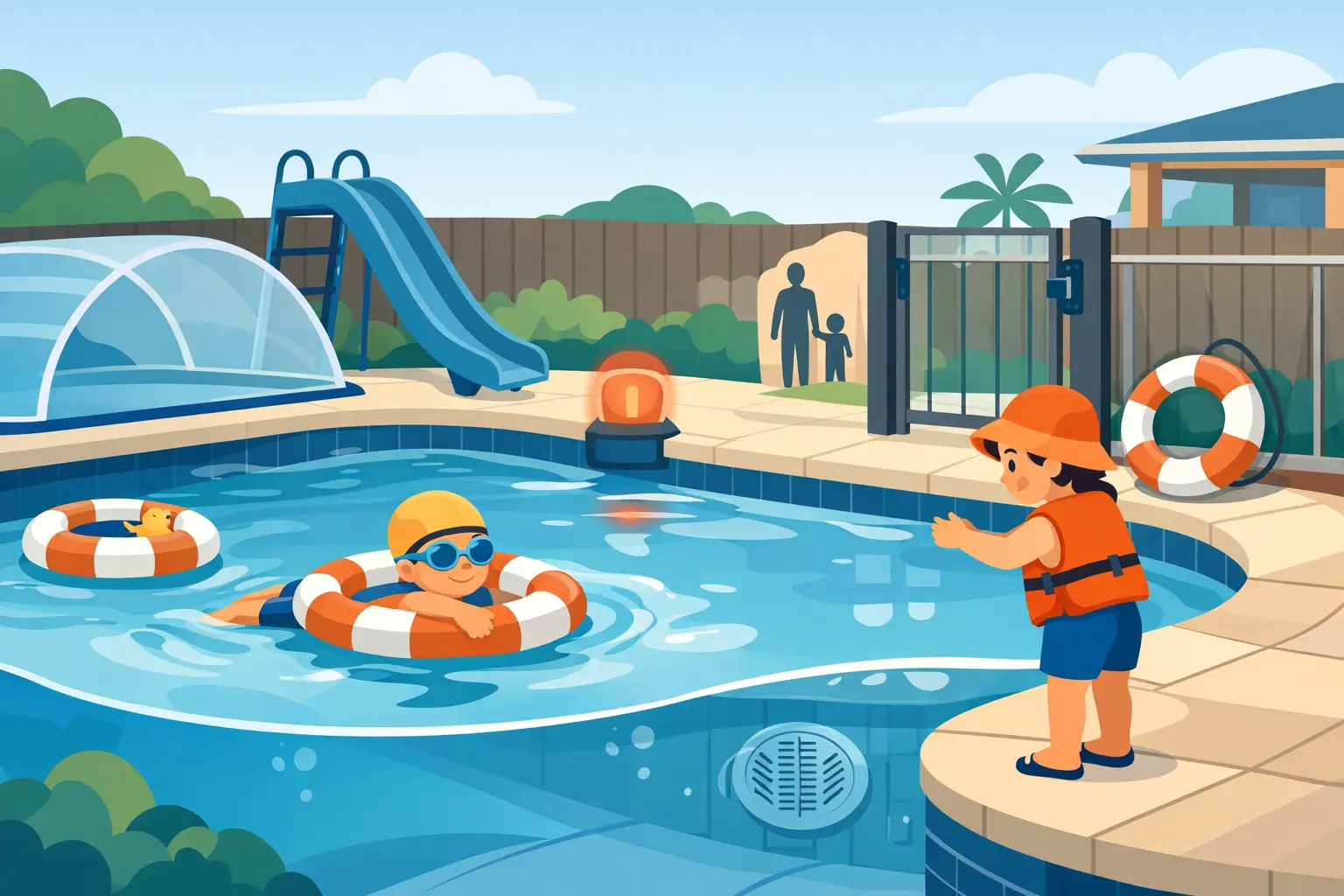
A beautiful backyard pool should feel relaxing, not uncertain. For families, that starts with choosing the right pool safety features for kids before the first swim, not after a close call.
Safety is rarely one product or one rule. It is a system. The strongest setup combines barriers, alerts, water circulation design, and clear supervision habits so one missed moment does not become something worse. That matters even more at home, where familiarity can make people let their guard down.
Why pool safety features for kids need layers
Children move fast, and water does not give much time for correction. A pool that looks calm can still present risk if access is easy, visibility is poor, or a safety feature depends too heavily on perfect adult behavior. That is why layered protection matters.
Think of it this way: a fence slows access, a self-closing gate reduces human error, an alarm adds awareness, and a cover creates another physical barrier when the pool is not in use. None of these replaces supervision. Together, they give families more margin.
There is also a practical side to this for homeowners. The best safety choices usually support the overall quality of the backyard. A well-placed fence can look clean and premium. Modern covers can protect water quality and reduce debris. Good lighting improves both evening atmosphere and visibility. Safety and design do not have to compete.
The pool safety features for kids worth prioritizing
Four-sided pool fencing
If one feature rises to the top, it is a four-sided fence that separates the pool from the house and yard. This matters because many accidents happen when a child gains unsupervised access, not during planned swim time.
A fence should be difficult for a child to climb, tall enough to deter access, and designed with gaps that do not create squeeze-through points. Families sometimes assume the backyard perimeter fence is enough. Usually it is not. A dedicated pool enclosure creates a true boundary around the water itself.
From a homeowner perspective, this is one of the clearest places where it pays to think long term. The right fence can work with the home’s architecture instead of looking like an afterthought.
Self-closing and self-latching gates
A gate is only helpful if it returns to a secure position every time. Self-closing and self-latching hardware solves a very common problem: adults forget. Kids follow. The latch should sit high enough that a small child cannot easily reach it.
This is a small detail with big value. In practice, gates fail more often from daily habits than from product defects. If the gate can be propped open during a party or left ajar after lawn work, the system is only as strong as the last person who used it. Automatic closing reduces that risk.
Pool alarms
Alarms add awareness, but they are not all the same. Some alert when a gate or door opens. Others detect water disturbance. Some systems combine multiple sensors.
For families with young children, door and gate alarms are often more useful than people expect because they warn you before entry happens. Surface or subsurface pool alarms can add another layer, though they may occasionally produce false alerts from wind, pets, or maintenance activity depending on the system. That trade-off is worth understanding before installation.
The right alarm setup depends on the property layout. A family room that opens toward the pool may benefit from one approach, while a fenced pool set farther into the yard may need another.
Safety covers
A true safety cover is very different from a basic solar blanket or lightweight cover. It is designed to support weight and prevent access when the pool is closed. For homes with kids, that distinction is critical.
Safety covers help in more than one way. They create a physical barrier, limit debris, and can support off-season care. But they also come with responsibilities. The cover must be properly fitted, correctly anchored, and kept in good condition. A loose, damaged, or partially open cover can create hazards of its own.
Automatic covers are appealing because they are easy to use, and easy usually means more consistent. That said, they still require maintenance and should not be treated as permission to relax supervision when the pool is open.
Drain covers and anti-entrapment protection
This is one of the least visible features and one of the most important. Poorly designed or outdated drains can create suction hazards. Modern anti-entrapment drain covers and compliant circulation design reduce that risk.
For many homeowners, this falls into the category of details they may never think about unless a pool professional brings it up. That is exactly why it matters. A safe pool is not just what you see around the edge. It also includes what is happening below the waterline and behind the equipment pad.
If a pool is older, this is especially worth reviewing during renovation or equipment updates.
Slip-resistant decking
Not every pool injury involves the water itself. Wet surfaces, running feet, and smooth finishes can lead to falls around the perimeter. Slip-resistant decking helps reduce that risk while still keeping the space polished and comfortable.
Material choice matters here. Some finishes perform better in wet conditions. Some stay cooler under summer sun. Some are easier to keep clean. The best option depends on climate, usage, and the look the homeowner wants to achieve.
This is a good example of where safety and everyday enjoyment overlap. A deck that feels secure underfoot is better for children, guests, and older family members alike.
Clear sightlines and lighting
A pool is easier to supervise when it is easy to see. Landscaping, raised features, decorative walls, and furniture can all create blind spots if the layout is not considered carefully.
Families often focus on what to install and overlook what to remove. Dense shrubs near a gate, oversized planters, or visual obstructions between the kitchen and pool can make supervision harder than it needs to be. Cleaner sightlines help adults react faster.
Lighting matters for the same reason. Underwater lights, deck lighting, and path lighting improve visibility during evening use and make the area easier to navigate safely. Ambience is a benefit, but function comes first.
Door and window barriers
When the house opens directly to the pool area, the home itself becomes part of the safety plan. Door alarms, high latches, and child-resistant locks can create another checkpoint between children and the water.
This is especially useful for younger families who spend most of their time moving between indoors and outdoors. A back door that opens without notice can undo the value of every other feature. Adding barriers at the house side closes that gap.
Swim-ready depth markers and rule setting
This is the simplest feature on the list, and one of the most practical. Clear depth awareness, posted expectations, and age-appropriate swim rules shape behavior before excitement takes over.
A backyard pool is meant to be used, and used often. That makes family habits part of the safety system. No child should rely on inflatable toys as if they are life-saving devices. No one should assume older siblings are supervision. And no pool should be treated as safe just because children have been in it many times before.
What homeowners often get wrong
The most common mistake is treating one feature as the answer. A fence alone is not enough. An alarm alone is not enough. Swim lessons alone are not enough. Every layer covers a weakness in another layer.
Another mistake is prioritizing convenience in ways that quietly weaken safety. Homeowners sometimes choose a gate style that looks better but latches poorly, or they leave furniture near a fence that creates a climbing aid. Small design decisions can have outsized consequences.
There is also the issue of maintenance. Safety equipment is only useful if it works. Gate hinges wear out. Alarm batteries die. Covers loosen. Drain components age. A safer pool is not something you install once and forget.
Building a safer pool without sacrificing the backyard experience
For most families, the goal is not to make the pool area feel restrictive. It is to make it feel well planned. The best pool safety features for kids blend into the space, support daily use, and reduce the chance that one distracted moment becomes a crisis.
That is why safety should be part of the pool conversation from the beginning, whether the project is new construction, a remodel, or a review of an older setup. Coastal Cove Pools approaches that conversation the same way a homeowner should – calmly, clearly, and with an eye on how the space will really be used.
A backyard pool should add comfort to the home. The right safety choices help it stay that way, season after season.