
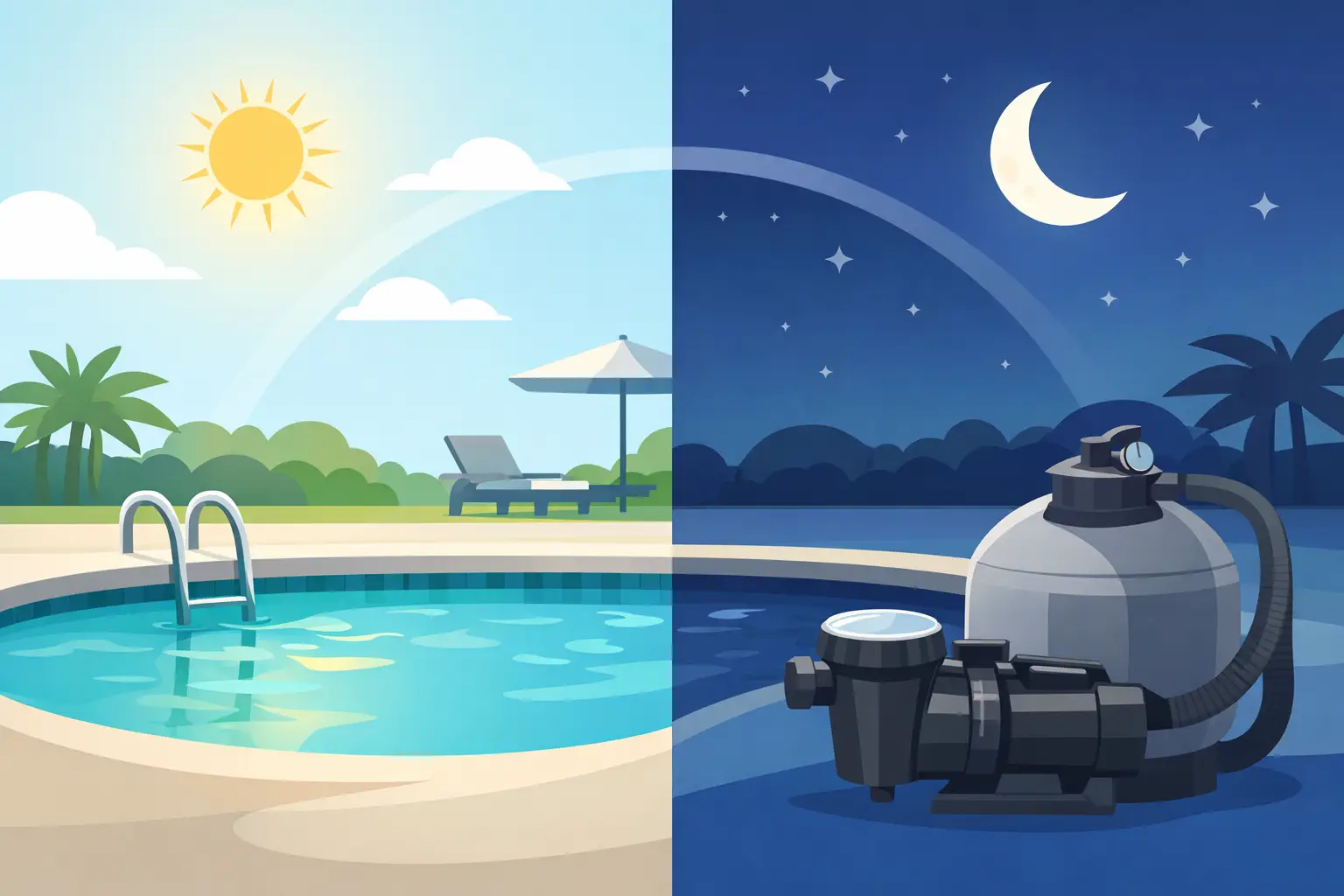
That jump in the electric bill usually gets people asking the same question: when should a pool pump run? Not all day, and not by guesswork. The right schedule depends on your pool, your equipment, your climate, and how often the water gets used. A good run time keeps water clear and balanced without paying for more circulation than you need.
For most residential pools, the sweet spot is somewhere between 8 and 12 hours a day in peak season. That is a useful starting point, not a rule carved in stone. A small screened pool in mild weather may need less. A large pool in full sun with heavy weekend use may need more. The goal is simple: move water often enough to support filtration, chemical distribution, and surface skimming.
When should a pool pump run in most homes?
If you want the short answer, start with 8 hours per day and adjust based on results. That works for many homeowners with a single-speed or variable-speed pump during warmer months. If the water stays clear, the skimmers pull debris well, and your chemistry remains stable, you are probably in the right range.
If the pool starts looking dull, debris lingers on the surface, or chlorine seems harder to maintain, the pump may not be running long enough. On the other hand, if the water is consistently clean and you are running a modern variable-speed pump, you may be able to spread circulation over a longer period at a lower speed and still use less energy.
The old idea that every pool needs a full turnover once or twice a day is not always the best way to think about scheduling. In real backyard conditions, water quality is driven by more than turnover alone. Skimming, filtration quality, sanitizer levels, sun exposure, and bather load all matter. That is why two pools on the same street can need different pump schedules.
What the pump is actually doing
A pool pump does more than push water in circles. It pulls water through the skimmers and main drain, sends it through the filter, and helps distribute chemicals evenly. Without enough circulation, chlorine can become less effective, dead spots can form, and fine debris can stay suspended or settle where you do not want it.
Run time also affects surface cleaning. Many leaves, bugs, pollen, and oils are easiest to remove while they are still floating. If your pump only runs overnight, you may miss the period when debris is actively collecting during the day. That is one reason many pools do better with some daytime operation, even if part of the schedule happens at night.
How long should a pool pump run by season?
Summer is when pools usually need the most circulation. Water is warmer, swimmers are in and out, sunscreen and body oils increase, and chlorine burns off faster in full sun. In that stretch, 10 to 12 hours a day is common, especially in hotter Southern markets.
Spring and fall usually allow a shorter schedule. Many homeowners can maintain clean, balanced water with 6 to 8 hours a day when temperatures are moderate and the pool is used less often. If leaves are dropping heavily in fall, though, skimming demand can push that number back up.
Winter is different. If the pool stays open year-round, many systems can run 4 to 6 hours a day in cooler weather, assuming freeze protection and water chemistry are handled properly. In freeze-prone conditions, the pump may need to run during very cold overnight hours to protect plumbing and equipment. That is not about filtration. It is about preventing damage.
The best time of day to run a pool pump
For many pools, the best schedule is not one single block. Splitting run time often works better. A few hours in the morning and a few in the afternoon or early evening can improve skimming and chemical circulation during the periods when the pool is actually collecting debris and getting used.
Daytime operation also helps when chlorine is being consumed fastest. If you add chemicals, you generally want enough run time afterward to circulate them thoroughly. If the pump only runs late at night, the water may not respond as evenly during the hottest part of the day.
That said, there is a trade-off. Some utility plans make off-peak hours cheaper. If lowering operating cost is the priority, you can shift more of the schedule into lower-cost periods as long as water quality does not slip. With variable-speed pumps, this is often easier to manage because lower speeds can run longer with less energy draw.
Single-speed vs. variable-speed changes the answer
Pump type matters. A single-speed pump does one thing: full power. That usually means shorter run times because each hour uses more electricity. Homeowners with single-speed systems often try to find the shortest daily schedule that still keeps the pool clean.
A variable-speed pump gives you more control. It can run longer at lower speeds, which is often more efficient and quieter. In practical terms, that means your pool might circulate for 12 hours or more while still using less energy than a single-speed pump running 6 to 8 hours.
This is where blanket advice falls apart. If someone says every pool should run exactly 8 hours a day, they are skipping over the equipment side of the equation. The better question is not just how long, but at what speed.
Signs your pool pump is not running enough
The water usually tells the story first. If the pool looks hazy, if debris hangs around near the tile line, or if you notice areas with poor circulation, increase the run time before assuming something major is wrong. A pool that struggles to hold chlorine or develops algae quickly may also need more circulation, though chemistry and filter condition should be checked too.
Another clue is uneven heating or inconsistent chemical readings from one side of the pool to the other. That can point to weak circulation. If your cleaner is not performing well, pump scheduling may be part of the issue, especially if the cleaner depends on active water movement.
Signs the pump may be running too much
The biggest sign is cost. If the water is clear, the chemistry is stable, and the pool is not dealing with unusual debris or heavy use, extra run time may just be adding to the power bill. Equipment wear is another factor. Pumps are built to run, but unnecessary operation still adds hours to motors, seals, and filters.
Too much run time does not usually hurt water quality, but it can mask the need for better calibration. A pool should not need marathon circulation every day under normal residential use. If it does, there may be an issue with filtration, chemistry, or hydraulics that should be addressed directly.
A practical way to find your ideal schedule
Start with a simple baseline. In warm weather, run the pump 8 hours a day for one week. Watch water clarity, skim performance, and chlorine stability. If the pool stays clean, reduce by an hour and observe again. If the water starts slipping, go back up.
If your pool gets a lot of sun, has a waterfall or spa spillway, hosts frequent swimmers, or sits under trees, be slower to cut time. If it is lightly used and protected from debris, you may be able to trim more. One schedule for every pool does not exist, even in the same neighborhood.
For variable-speed systems, think in terms of programming rather than just hours. Low speed for everyday filtration, higher speed for skimming, cleaners, heaters, or water features often makes more sense than running high all day. This is usually where a professional setup pays off because a few programming changes can improve both water quality and efficiency.
When should a pool pump run after adding chemicals or heavy use?
After adding most pool chemicals, the pump should run long enough to fully circulate the water. A few hours is usually the minimum, and longer may be appropriate depending on what was added. After a pool party, storm, or very hot day, extra run time also makes sense. Those are not normal conditions, and the schedule should reflect that.
Think of pump timing as seasonal and situational, not fixed forever. A pool is part of the home, but it is also exposed to weather, heat, debris, and use patterns that change week to week.
A clean pool does not come from running the pump as long as possible. It comes from running it with purpose. If your water is clear, your system is properly set, and the schedule matches how your pool actually lives in your backyard, you are right where you want to be.