
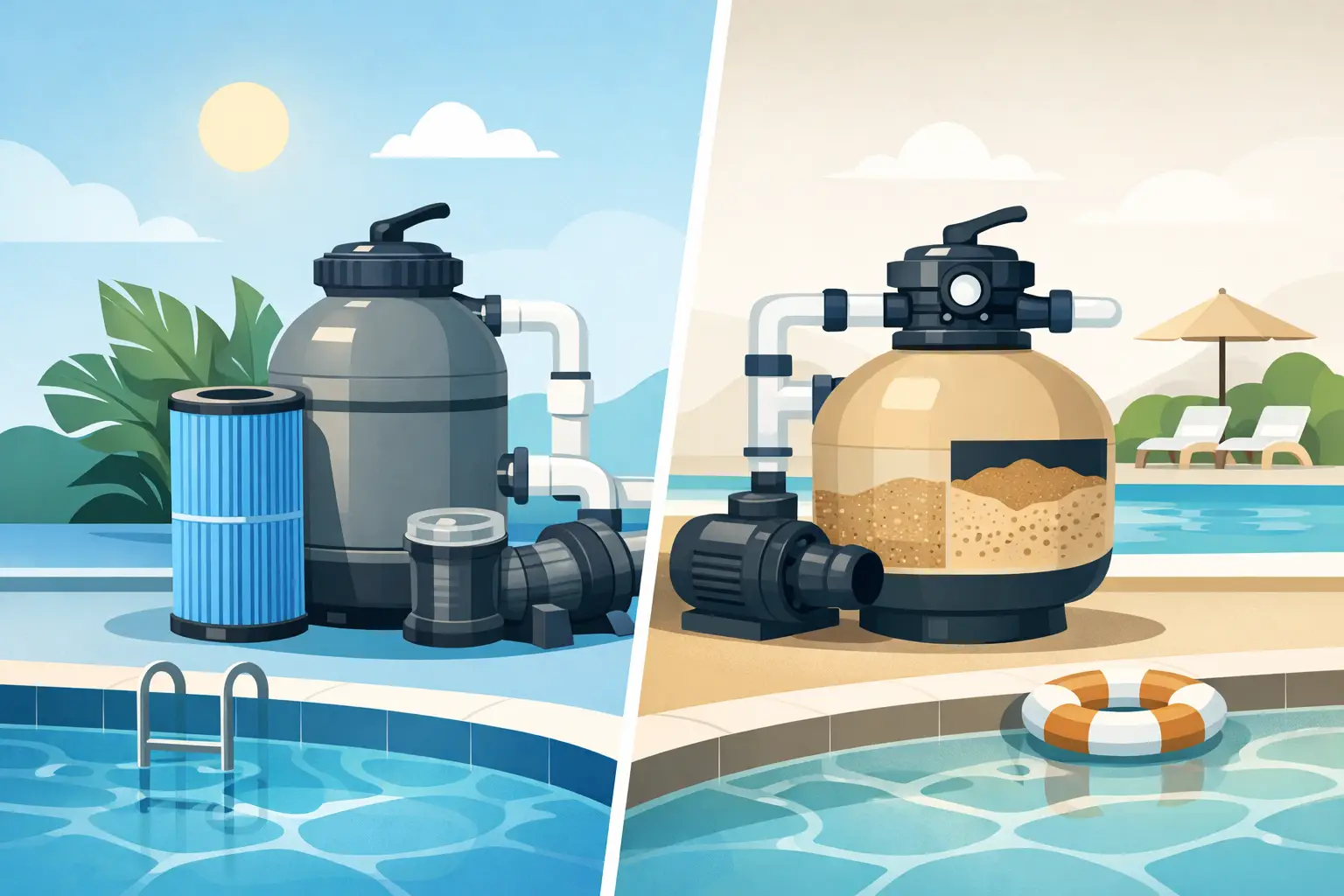
A pool can look beautiful from the patio and still have a filtration system working harder than it should. The cartridge filter vs sand filter decision affects water clarity, weekly upkeep, water use, and how your pool feels during the season. Neither option is automatically best. The right one fits the pool, the household, and the way you want to spend your weekends.
For homeowners building a new pool or replacing aging equipment, the choice usually comes down to a simple question: Do you prefer the straightforward routine of backwashing a sand filter, or the finer filtration and lower water use of a cartridge filter?
Cartridge Filter vs Sand Filter: The Main Difference
Both systems move pool water through a filter tank, capture debris, and return cleaner water to the pool. The filtering material is what changes the experience.
A sand filter uses specially graded silica sand, or sometimes glass media, inside the tank. Water passes through the media, which catches debris. When pressure rises, the filter is cleaned by reversing the water flow and sending dirty water out through a backwash line.
A cartridge filter uses one or more pleated fabric elements. Water passes through the material, and particles collect on its surface. When the filter needs cleaning, the cartridges are removed and rinsed with a hose.
That difference sounds small, but it shapes nearly every practical trade-off: clarity, water conservation, labor, plumbing requirements, and operating habits.
Water Clarity and Filtration Performance
Cartridge filters generally capture finer particles than standard sand filters. A typical cartridge filter can trap debris in roughly the 10- to 20-micron range, while a standard sand filter often filters in the 20- to 40-micron range. Exact performance depends on the filter model, circulation time, water chemistry, and the condition of the media or cartridges.
In practical terms, cartridge filtration can produce especially polished water with less help from clarifiers. Fine dust, pollen, and suspended debris are more likely to be caught before they cloud the pool. This can be appealing for a backyard designed around clean lines, bright water, and frequent entertaining.
A sand filter still delivers clear, healthy water when it is properly sized and maintained. Its performance can improve as a light layer of trapped material develops in the sand bed. Sand filters are not inferior systems. They are proven, durable, and common for good reason. They simply do not usually filter as finely as cartridges without additional products or specialized media.
Water clarity is also not a filter-only issue. Balanced chemistry, sufficient pump run time, brushing, skimming, and prompt treatment after storms or heavy use matter just as much. The best filter cannot correct neglected water.
Maintenance: Backwashing or Cleaning Cartridges
Sand filters are known for their simple cleaning process. When the pressure gauge rises around 8 to 10 psi above the normal clean operating pressure, you turn the multiport valve to backwash, run the pump until the sight glass clears, rinse briefly, and return the system to filter mode. It is fast and familiar for many owners.
The trade-off is water loss. Every backwash sends pool water and treated chemicals out of the system. You will need to add fresh water afterward, then check the chemistry. In areas with water restrictions, high water costs, or frequent wind-blown debris, that routine deserves consideration.
Cartridge filters do not need backwashing. Pressure rises as the cartridges collect debris, and cleaning typically means shutting down the equipment, opening the tank, removing the cartridges, and rinsing between the pleats. It takes more hands-on time than turning a valve, especially if the cartridges are heavily soiled.
For a normally used residential pool, cartridge cleaning may be needed once or twice a year. A pool surrounded by trees, exposed to construction dust, or recovering from algae may need attention more often. Cartridges also benefit from periodic deep cleaning with a filter-safe solution to remove oils, sunscreen residue, and mineral buildup.
The better maintenance choice depends on your preference. Sand is easier at the moment it needs cleaning. Cartridge is less frequent and conserves water, but each cleaning is more involved.
What Happens After a Storm or Algae Problem?
This is where the decision can feel more personal. Sand filters are forgiving when a pool sees heavy debris loads. Backwashing is quick, and the filter can return to work immediately. For homes with lots of mature landscaping, frequent storms, or an active group of swimmers, that simplicity has value.
Cartridge filters can become loaded during an algae cleanup or after a severe weather event. They may need repeated rinsing while the water recovers. Still, their large filtration area and fine particle capture can help polish water once the heavy cleanup is under control.
Water Use and Energy Considerations
Cartridge filters have a clear advantage in water conservation because they do not require routine backwashing. Less replacement water also means fewer chemicals are needed to rebalance the pool after cleaning.
They often operate at lower pressure than comparable sand systems, which can support efficient circulation when the equipment is correctly matched. That does not mean a cartridge filter automatically creates dramatic energy savings. Pump type, plumbing design, filter sizing, and daily run time have a greater effect on the electric bill.
Sand filters use water when backwashed, but they offer a benefit of their own: the cleaning process is built into the system. There are no fabric elements to remove, inspect, rinse, and reinstall. For some owners, that convenience outweighs the added water use.
If water conservation is a priority for your household, cartridge deserves a close look. If you want the most direct cleaning routine possible, sand may feel more comfortable.
Upfront Cost and Long-Term Replacement
Initial equipment cost varies by pool size and brand, but cartridge filter systems often cost more upfront than basic sand filter setups. Larger cartridge filters also need adequate room at the equipment pad, since the tank must be opened and cartridges lifted out for service.
Sand filters generally have lower initial costs and a long service life. The sand itself commonly lasts five to seven years, sometimes longer with good water balance and proper backwashing. Eventually, the media becomes rounded, compacted, or less effective and should be replaced.
Cartridges usually need replacement sooner than sand media. Depending on water balance, cleaning habits, and pool use, they may last about two to four years. Replacement cartridges are an ongoing ownership cost, particularly for larger multi-cartridge systems.
Do not choose solely by the price tag on installation day. Consider the full picture: replacement parts, water costs, cleaning time, local conditions, and how long you expect to own the pool.
Which Filter Fits Your Backyard?
A cartridge filter is often the better fit for homeowners who value fine filtration, want to minimize water waste, and are comfortable with occasional hands-on cleaning. It works especially well for pools where visual clarity is a high priority and the equipment pad has sufficient access space.
A sand filter is often the better fit for homeowners who want a durable, familiar system with a quick backwash routine. It can be an excellent choice for properties with heavy leaf load, families who prefer simple equipment operation, and pools where occasional water loss from backwashing is not a major concern.
Filter size matters as much as filter type. An undersized cartridge filter will need frequent cleaning. An undersized sand filter will see pressure rise quickly and may require repeated backwashing. A properly sized system gives water room to move, captures debris more effectively, and reduces unnecessary maintenance.
Pump selection matters, too. A variable-speed pump paired with the right filter can provide steady circulation at a lower operating speed, improving efficiency without sacrificing water quality. Equipment should be designed as a system, not chosen as separate pieces.
Make the Choice Around How You Use the Pool
A quiet pool used by two adults, with a clean deck and low debris, has different needs than a busy family pool with kids, pets, guests, and trees overhead. There is no prize for choosing the most expensive filter or the most traditional one. There is only the system that supports reliable water quality without adding friction to your life.
Coastal Cove Pools helps homeowners look beyond the equipment label and consider the full backyard experience. A filter should keep the water inviting, protect the equipment investment, and leave more time for the part that matters: enjoying the pool.
Before making a final decision, look at your water source, landscaping, local water rules, equipment-pad space, and comfort with maintenance. The right filter is the one you can care for consistently, season after season, while your backyard remains a place to step outside and stay awhile.