
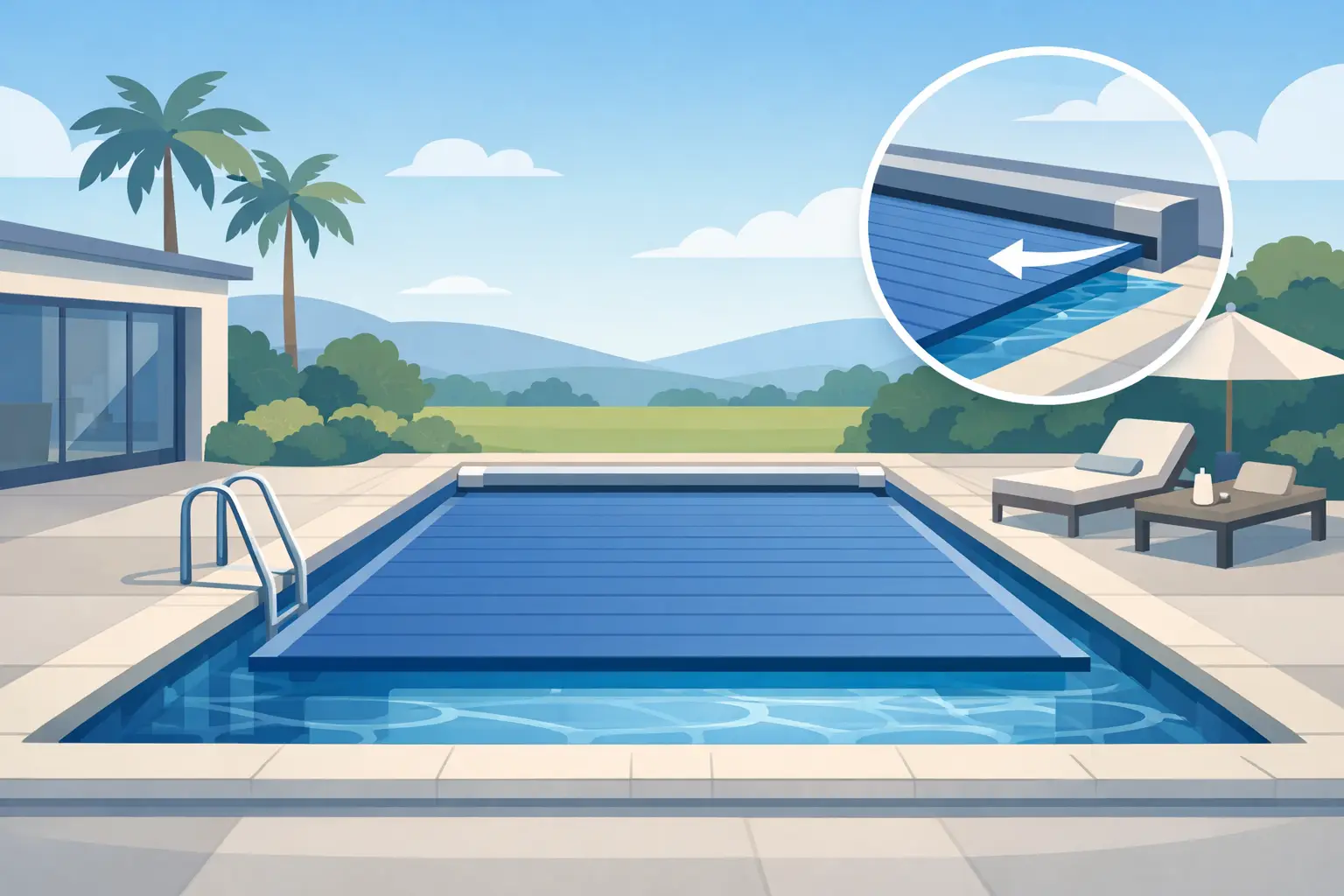
A pool cover can make a backyard feel more finished, private, and easy to manage. But automatic cover safety is about more than pressing a switch at the end of the day. It depends on the cover itself, the equipment below the deck, the way the family uses the pool, and whether the system is kept in proper working order.
For homeowners, an automatic cover can be one of the most practical upgrades around a residential pool. It can help reduce evaporation, hold in heat, limit debris, and create a cleaner visual line across the water. When selected and maintained as a true safety system, it can also add a meaningful layer of protection. The distinction matters: not every automatic cover is designed, rated, or installed to serve as a safety cover.
What Automatic Cover Safety Actually Means
A safety-rated automatic pool cover is built to support weight and help prevent unintended entry into the pool when it is fully closed, properly secured, and operating as intended. In the United States, homeowners should ask whether a cover meets ASTM F1346, the recognized standard for safety pool covers. This is one of the clearest starting points when comparing systems.
A motorized cover is not automatically a safety cover simply because it opens and closes with a key, switch, or remote control. A lightweight thermal blanket, for example, can improve water temperature and reduce evaporation, but it is not made to keep a person or pet above the water. Treating the wrong type of cover as a safety barrier creates a serious risk.
Even a properly rated system is one layer of a larger safety plan. Fencing, self-closing gates, door alarms where appropriate, clear family rules, and active adult supervision all still have a place. A cover reduces access when the pool is closed. It does not replace attention when people are in or around the water.
The Details That Make a Cover Safer
The most dependable automatic cover safety begins before installation. The pool shape, deck layout, cover housing, drainage, and equipment access all affect how the system will perform over time. A cover that tracks smoothly and closes fully is easier to use every day. A cover that binds, collects water, or has damaged guides may be ignored or misused precisely when it is needed most.
The cover fabric should be sized and tensioned correctly. It needs to span the pool with appropriate support, sit securely in its tracks, and close without wide gaps at edges or steps. The tracks, ropes, pulleys, reel, and motor work together. Wear in one area can place stress on another, which is why a system that seems only slightly off should not be left for months.
Drainage deserves special attention. Rainwater can collect on top of a closed cover, especially after coastal storms or heavy seasonal weather. Standing water adds weight and can conceal the fact that the pool is covered. Many systems use a cover pump to remove water from the surface. That pump should be tested regularly and placed correctly, with its discharge routed away from the pool deck and home foundation.
A cover with a large volume of water on top should be treated with care. Keep children and pets away from it. Do not walk across it, and do not assume that a floating pool toy or leaf net changes the risk. Remove surface water before opening the cover whenever possible.
Controls Should Limit Unsupervised Use
Automatic cover controls should be positioned and used with intention. Many safety systems use a key-operated or hold-to-run control, meaning the user must remain at the control and maintain contact while the cover moves. This allows the operator to watch the entire pool surface during opening and closing.
The person operating the cover should have a clear view of the water and deck. Before closing, confirm that everyone is out of the pool, including pets, and remove large toys or furniture that could interfere with the cover. Before opening, look for accumulated water, debris, or an object caught along a track.
Keys and remotes should not be left where young children can access them. If a control needs repair or begins operating inconsistently, discontinue use until it has been evaluated. Trying to force a cover open or closed can damage the mechanism and may turn a manageable service issue into a larger repair.
Daily Habits Matter as Much as the Hardware
The strongest cover system is the one a household actually uses. For many families, that means making closure part of the normal pool routine: the pool is closed when swimming is finished, when the backyard will be unattended, and overnight.
Consistency matters because open pools invite spontaneous use. A child may follow a pet outside. A guest may not understand the house rules. An automatic cover gives homeowners a simple way to establish a clear visual signal: the pool is open for use or it is closed for the day.
That routine should include a quick check of the cover each time it moves. Watch the leading edge as it crosses the water. Listen for unusual sounds from the motor or mechanism. Look for frayed ropes, worn webbing, damaged fabric, or track sections that appear loose. Small changes are often easier and less expensive to correct early.
There are trade-offs. A cover can make daily pool care easier by reducing leaves and evaporation, but it may also hold in heat and affect water chemistry. In warm weather, covered water can become hotter than expected. In some conditions, reduced sunlight and limited circulation may influence sanitizer demand or algae risk. A regular maintenance plan should account for how often the pool is covered, not treat the cover as a substitute for circulation, testing, or chemical balance.
Automatic Cover Safety During Service and Repairs
Automatic covers are hardworking pieces of pool equipment. Sun exposure, chlorinated water, windblown grit, repeated movement, and changing temperatures all take a toll. Like a pump or heater, the cover needs periodic professional attention.
A service inspection can identify tension issues, rope wear, track alignment problems, debris in the housing, motor concerns, and aging fabric before a full failure occurs. This is especially valuable before peak swim season, after major weather events, or when a home has changed hands and the new owner is still learning the pool’s equipment.
Homeowners should avoid improvising repairs to cables, ropes, electrical controls, or the drive mechanism. These components are under tension and can be hazardous when handled incorrectly. A torn cover, jammed reel, or cover that stops midway may look straightforward from above, but the cause can be hidden in the cover vault or mechanical assembly.
If the cover cannot close completely, use other pool barriers and increase supervision until it is repaired. Do not assume a partly closed cover provides the same protection as a fully closed, secured system. It does not.
Questions to Ask Before Choosing a System
A good purchase conversation should go beyond color and convenience. Ask whether the proposed cover is safety rated, how it will fit the specific pool shape, where the mechanism will be housed, and how drainage will be handled. Ask what regular service looks like, what parts tend to wear, and what the expected lifespan of the fabric and mechanical components may be in your climate.
It is also wise to ask about local requirements. Pool barrier rules, permit requirements, and homeowner association standards can vary by municipality and neighborhood. A qualified pool professional can help homeowners understand how an automatic cover fits into the larger safety and compliance picture.
For a new pool, planning the cover early often produces the cleanest result. The deck, coping, steps, and equipment layout can be coordinated around the system rather than adapted later. Existing pools can often be retrofitted, but the right approach depends on the pool structure, deck condition, and available space.
An automatic cover should make pool ownership feel easier, not more complicated. Choose a properly rated system, use it every time the pool is unattended, and give it the same consistent care as the water and equipment below it. That is how a polished backyard feature becomes a dependable part of a safer home.