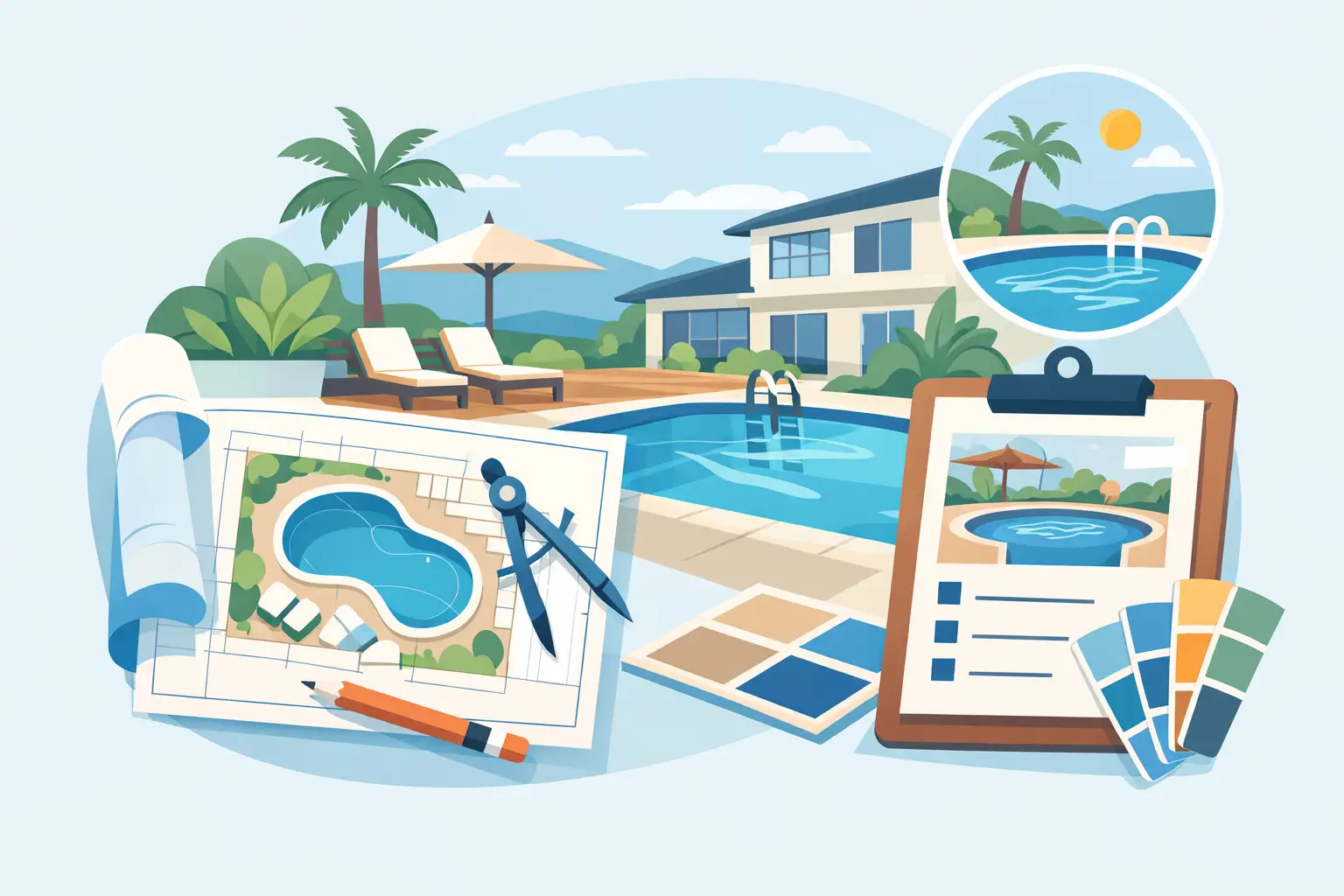
A good pool starts long before excavation. The real work in a guide to residential pool design planning happens at the decision stage – when size, shape, placement, budget, and upkeep all need to make sense together.
Homeowners usually begin with a picture in mind. Maybe it is a clean rectangle for lap swimming, a resort-style pool with a tanning ledge, or a family layout that keeps kids in view from the patio. The picture matters, but planning is where a pool either becomes a smart home upgrade or an expensive compromise.
What a guide to residential pool design planning should solve
Pool planning is not just about picking a look. It is about making sure the pool fits the property, supports how the household actually lives, and remains manageable after installation. A pool that photographs well but crowds the yard, overwhelms the budget, or creates maintenance headaches will not feel relaxing for long.
Most planning mistakes come from treating design as decoration. In reality, residential pool design is a balance of aesthetics, engineering, circulation, safety, and long-term ownership. That balance is what separates a polished backyard from a project that never feels fully resolved.
Start with how the pool will be used
The fastest way to narrow the design is to decide what the pool is meant to do most days, not just on holiday weekends. Families with young children often need wide shallow areas, easy entry points, and clear sight lines from the house or outdoor seating. Homeowners who entertain may care more about lighting, deck flow, and how the pool frames the entire yard at night. Fitness-focused households may want a longer, simpler shape that favors swimming over lounging.
This is where trade-offs show up early. A tanning ledge looks great and adds usable space, but it also reduces swim area. A freeform pool can feel relaxed and natural, but a geometric pool often uses space more efficiently. A deep end may sound appealing, yet many homeowners end up spending more time in shallow, social areas.
Planning around real use usually leads to better choices than planning around trend images.
Read the yard before choosing the pool
Every backyard sets limits. Lot size, slope, drainage, existing trees, utility locations, easements, access for construction, and local setback rules all affect what can be built and where. A pool that fits on paper may not fit once these realities are mapped out.
Sun exposure also matters more than many people expect. A pool placed for maximum afternoon sun may feel ideal for swimming, while a pool with too much shade can run cooler and collect more debris. Wind patterns matter too. A windy spot increases evaporation, affects comfort, and can push leaves and dirt into the water.
Then there is the relationship to the house. The pool should not feel dropped into leftover space. It should connect naturally to the back door, covered patio, outdoor kitchen, or lounge area. Good planning makes the yard feel organized. Poor planning makes every feature compete.
Pool placement affects daily ownership
Placement is often discussed as a design issue, but it is also an ownership issue. If equipment is too close to entertainment areas, noise becomes a frustration. If the pool is too far from the house, supervision and convenience suffer. If decking routes feel cramped or awkward, the space will never flow well.
The best layouts make movement easy. You should be able to step outside and understand the yard immediately – where people gather, where children enter the water, where furniture belongs, and where service access remains clear.
Choose a shape that matches the property
Pool shape should follow architecture and use. On a modern home, a crisp rectangular pool often feels intentional and clean. On a softer landscape with curved beds and a more relaxed outdoor setting, a freeform shape may feel more natural.
That said, shape should not be chosen on style alone. Rectangular pools are often easier to cover, easier to measure, and better for lap swimming. Freeform pools can soften a yard and create a custom feel, but they may complicate automatic covers, decking geometry, or furniture layout. Neither is universally better. It depends on the home, the lot, and the owner.
The same goes for features like spas, baja shelves, benches, and waterfalls. They can elevate the experience when they support the layout. They can also clutter the design when added without purpose.
Budget for the full project, not just the shell
One of the most common planning errors is budgeting around the pool structure alone. In reality, residential pool projects include much more: decking, coping, tile, fencing, drainage work, electrical, lighting, landscaping repair, equipment, and often upgrades to outdoor living areas around the pool.
A realistic budget also accounts for finish level. Material choices change the feel of the project quickly. Simple finishes can still look refined when the layout is strong. Premium finishes can look excessive if the plan underneath is weak.
It helps to separate must-haves from nice-to-haves early. If the budget has pressure points, prioritize the structural and layout decisions that are hardest to change later. Decorative upgrades can often wait. Moving plumbing, changing depth profiles, or resizing decking after the fact is much harder.
Plan for operating costs too
A responsible guide to residential pool design planning includes life after construction. Pools come with ongoing costs for cleaning, chemicals, water balance, equipment service, electricity, and occasional repairs. Design choices influence all of that.
Larger pools cost more to run. Complex water features can add maintenance and energy use. Mature landscaping near the water may look beautiful but can increase debris load. Even the finish and circulation design affect how easily the pool can be cared for.
That does not mean avoiding features. It means understanding the ownership side before decisions are locked in.
Equipment choices should support simplicity
Most homeowners care about performance, but what they really want is fewer problems. Equipment planning should focus on reliability, efficiency, and ease of control. Pumps, filters, heaters, sanitizing systems, automation, and lighting all shape the ownership experience.
This is one area where minimalism often wins. The best setup is not always the one with the longest feature list. It is the one that keeps the water clear, the system efficient, and day-to-day use straightforward.
Automation is especially useful when it simplifies routine tasks like managing schedules, lights, heating, and water features. For many homeowners, that convenience is worth more than adding one more visual upgrade.
Safety and code should be built into the design
Safety is not a separate conversation from design. It is part of design. Fencing, gates, alarms, entry points, deck surfaces, depth transitions, and visibility lines all deserve attention at the planning stage.
Families with children often benefit from layouts that preserve direct views into the water from the home and primary seating areas. Slip resistance around the pool matters. So does enough deck space for people to move comfortably without crowding the waterline.
Local code and permit requirements will shape parts of the project, but smart planning goes beyond minimum compliance. A backyard pool should feel easy to use safely, not just technically approved.
Think in zones, not just water
The pool is the anchor, but the yard experience depends on what surrounds it. A strong plan usually creates clear zones for swimming, lounging, dining, shade, and circulation. That zoning is what makes a backyard feel complete instead of unfinished.
This is where scale matters. An oversized pool can leave no room for furniture or entertaining. A pool that is too small can feel visually lost in a large yard. The right proportion gives the water presence while preserving enough hardscape and softscape to support everyday use.
For many homes, the most successful design is not the biggest or most elaborate. It is the one that makes the whole backyard easier to enjoy.
Work with the long view in mind
A pool should fit the next several years of life, not just the current moment. A family with small children may later want more room for entertaining. A couple designing for quiet evenings may later value low-maintenance systems even more than visual extras. A property intended for long-term ownership may justify stronger investment in durable materials and layout quality.
This long view is where an experienced planning process earns its value. It helps homeowners avoid decisions that feel exciting now but limiting later. Coastal Cove Pools approaches planning with that ownership mindset – not just how the pool looks on day one, but how it lives over time.
A well-planned pool feels natural from the start. It belongs to the house, the yard, and the people using it. If the planning is right, the finished space does not feel complicated. It just feels like where you want to be.