Clear pool water can fool you. It may look perfect in the morning and still be headed toward algae, scale, eye irritation, or equipment wear by the weekend. That is why a beginner guide to pool water chemistry matters for any homeowner who wants the pool to feel easy, clean, and ready to enjoy instead of becoming another thing to troubleshoot.
Pool chemistry sounds technical at first, but the basic idea is simple. You are keeping the water sanitized, balanced, and protected from conditions that make it unstable. Once you understand what each reading means, the whole routine becomes more manageable.
A beginner guide to pool water chemistry starts with balance
Most new pool owners focus on chlorine first, which makes sense. Chlorine is the sanitizer that helps keep water safe and clear. But chlorine works best when the rest of the water is in range. If pH is off or alkalinity drifts too far, you can add chemicals and still feel like nothing is responding the way it should.
The core readings to know are free chlorine, pH, total alkalinity, calcium hardness, and stabilizer, also called cyanuric acid. Some pools also need attention to salt levels, phosphates, or metals, but those are not the first numbers to obsess over.
Free chlorine is what actively sanitizes the water. For most residential pools, a general target is 1 to 3 parts per million, though the right level can shift based on sun exposure, pool use, and stabilizer level. If your pool gets full sun all day, chlorine burns off faster, so your routine may need adjustment.
pH tells you whether the water is too acidic or too basic. Most pools do best between 7.2 and 7.6. When pH climbs too high, chlorine becomes less effective and scale can form. When it drops too low, water can become corrosive and irritating.
Total alkalinity helps buffer pH. Think of it as the control point that keeps pH from swinging too fast. A common target is 80 to 120 parts per million, but the ideal number depends somewhat on your pool finish, sanitizer type, and local water conditions.
Calcium hardness matters because water always tries to reach equilibrium. If calcium is too low, water can become aggressive and pull minerals from plaster and grout surfaces. If it is too high, scale can form on tile, heaters, and inside plumbing. Many residential pools do well around 200 to 400 parts per million, though plaster pools often need more attention here than vinyl liner pools.
Stabilizer, or cyanuric acid, protects chlorine from sunlight. Without it, chlorine can disappear quickly on a bright day. Too little stabilizer makes chlorine short-lived. Too much can slow chlorine down and make sanitation harder. For many outdoor pools, 30 to 50 parts per million is a workable range, though some systems vary.
What pool owners should test and how often
A good beginner guide to pool water chemistry should make one thing clear: consistency beats overcorrection. Most water problems start small, then grow because no one checked the pool for several days or because too many chemicals were added at once.
During swimming season, test free chlorine and pH at least two to three times per week. If the pool is used heavily, gets a lot of rain, or sits in strong sun, daily testing may be worth it. Total alkalinity, calcium hardness, and stabilizer can usually be checked weekly or monthly depending on conditions and whether the pool has been stable.
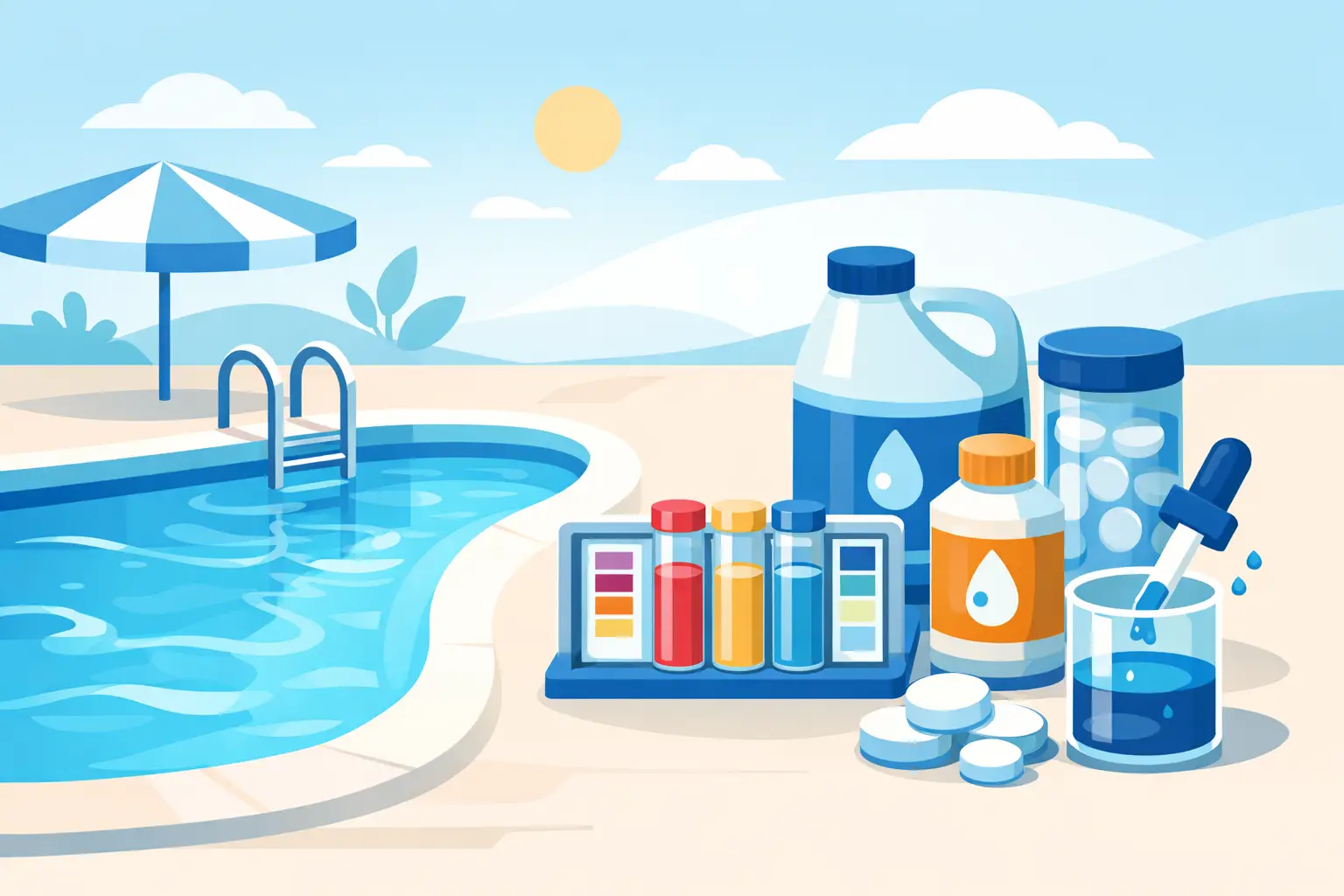
Test strips are quick and easy, but liquid test kits tend to be more precise. If you are new to pool care, accuracy matters. Guesswork leads to chasing numbers, and chasing numbers usually means spending more than necessary.
It also helps to test at roughly the same time of day. Chlorine levels change with sunlight and swimmer load, so random testing can make readings seem more confusing than they are.
How the readings affect each other
This is where many beginners get tripped up. Pool chemistry is not a set of isolated numbers. One adjustment often affects another.
If pH is high, chlorine loses efficiency. That can make water look dull even when chlorine appears present. If alkalinity is high, pH may keep drifting upward no matter how often you lower it. If stabilizer is too high, chlorine may test in range but still feel less effective in real-world use.
That is why it makes sense to correct chemistry in a logical order. Start with chlorine and pH because they have the most immediate effect on water quality and swimmer comfort. Then review alkalinity, calcium hardness, and stabilizer. In some cases, trying to perfect every number at once creates more fluctuation, not less.
There is also an it-depends factor. A plaster pool in a hot climate with hard fill water behaves differently than a vinyl pool in a milder region. The exact target range may shift slightly based on surface type, equipment, and source water. The goal is not perfect lab water. The goal is stable, comfortable water that protects the pool.
The most common chemistry mistakes beginners make
The biggest mistake is adding chemicals before testing. The second is adding too much because the first dose did not seem to work instantly. Pool water needs circulation time. In many cases, the right move is to add one product, let it mix, then retest.
Another common mistake is treating symptoms instead of causes. Cloudy water does not always mean low chlorine. It can also point to filtration issues, high pH, poor circulation, or early algae growth. Burning eyes are often blamed on chlorine, but unbalanced pH or chloramines can be the real issue.
New pool owners also tend to ignore stabilizer until chlorine becomes hard to manage. In outdoor pools, stabilizer is a major part of the equation. Without enough, chlorine disappears too fast. With too much, water can become stubborn and require partial draining to correct.
Then there is the temptation to buy every specialty product on the shelf. Clarifiers, phosphate removers, enzyme treatments, and other additives can have a place, but they are not the foundation. Most pools improve dramatically when the basics are handled well.
A simple routine for easier pool care
Start with a weekly rhythm. Test the water, clean out debris, empty baskets, and check that circulation is normal. Make small chemical adjustments instead of large ones. Brush the walls and steps so early buildup does not settle in. A clean pool holds balance more easily than a neglected one.
Keep notes. If you add acid, chlorine, or calcium, write down how much and when. After a few weeks, patterns start to show. You may notice that your pool consistently needs pH correction after heavy rain, or that chlorine demand rises when the water gets warmer. That kind of predictability makes ownership easier.
Pay attention after storms, parties, or heat waves. Those are the moments when clean water can slip out of range quickly. More swimmers bring more contaminants. Rain can dilute chemistry and change balance. Hot weather speeds up chlorine loss.
If you use tablets, know that many add stabilizer over time. That is not necessarily bad, but it becomes a problem when no one tracks the cumulative effect. Liquid chlorine adds no stabilizer, which gives you more control, though it requires more frequent dosing. Neither method is automatically better for every homeowner. It depends on how hands-on you want to be and how your pool behaves.
When to handle it yourself and when to call for help
Routine testing and basic adjustments are realistic for many homeowners. If your pool is generally stable, learning the chemistry can save time and prevent preventable issues. It also helps you spot problems before they become expensive.
But some situations call for a more experienced eye. Persistent cloudiness, recurring algae, heavy scale, staining, or chemistry that swings wildly despite regular care usually means there is a deeper issue. Water balance may be off, but so might filtration, circulation, or equipment performance.
That is where a service-led approach matters. Homeowners do not need to become chemists to enjoy their pool. They just need enough understanding to protect the investment, ask the right questions, and keep small issues from turning into major cleanup.
A pool should feel like part of home life, not a constant science project. Learn the few numbers that matter most, stay consistent, and avoid rushed corrections. Clear water is rarely an accident. It is the result of simple habits done on time, so the pool stays ready when you are.