
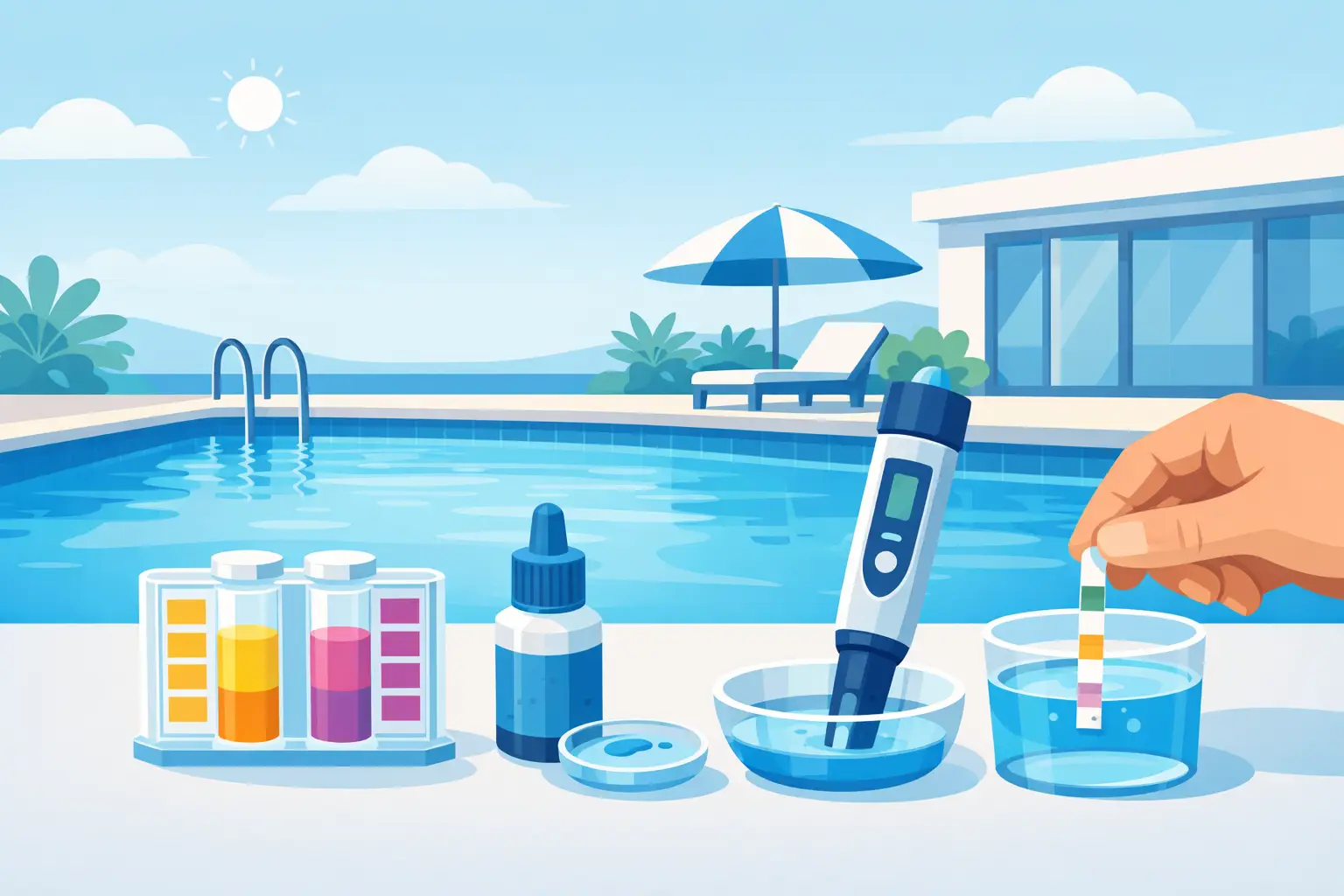
If you have ever looked at clear pool water and still wondered whether it was actually balanced, you are asking the right question. What is the best pool water test method is not just a chemistry question. It is a maintenance question, a cost question, and for most homeowners, a peace-of-mind question.
A pool can look clean and still be off. Chlorine may be low, pH may be drifting, or alkalinity may be setting you up for cloudy water a day later. The best testing method is the one that gives you dependable readings before small issues turn into bigger ones. For most residential pool owners, that usually means a liquid drop test kit for routine accuracy, with test strips as a quick check and professional testing as a smart backup when something feels off.
What is the best pool water test method for most homeowners?
For day-to-day residential pool care, the best balance of accuracy, cost, and usability is usually a liquid reagent test kit. It takes a little more time than a strip, but not enough to be a burden, and the results are generally more reliable.
That matters because pool chemistry is connected. If your pH is high, chlorine becomes less effective. If alkalinity is unstable, pH can swing. If calcium hardness is out of range, surfaces and equipment can suffer. A testing method that gives you better confidence in the numbers helps you make smaller, smarter adjustments.
Test strips are faster. Digital testers are convenient. Water testing at a pool store or through a service company can add another layer of insight. But if you want one method to rely on week after week at home, liquid testing tends to be the strongest choice.
The main pool water testing methods
Test strips
Test strips are popular for a reason. They are fast, simple, and easy to keep on hand. You dip the strip, wait a few seconds, and compare colors. For a busy homeowner who wants a quick snapshot before the weekend, that convenience is hard to ignore.
The trade-off is precision. Strips can be affected by humidity, storage conditions, lighting, and simple color interpretation. Two people can look at the same strip and read it slightly differently. They are useful for quick screening, but less useful when you need a clear answer on a water problem.
If your pool is already stable and you test often, strips can be a practical monitoring tool. If your water has turned cloudy, chlorine is disappearing too fast, or your readings seem inconsistent, strips are usually not the best method to rely on alone.
Liquid drop test kits
Liquid test kits take a bit more effort, but they are widely trusted because they give clearer, more consistent results. You collect a water sample, add reagents, and match the result to a comparator or count drops to reach an endpoint.
This method is especially useful for testing chlorine and pH with better confidence than strips. Higher-quality kits also cover total alkalinity, calcium hardness, and stabilizer. For homeowners who want to protect their finish, equipment, and swimming experience, that broader view matters.
The downside is that these kits require a little routine. Reagents need to be stored properly and replaced when they age out. You also have to follow directions carefully. But once you get used to the process, it becomes a straightforward part of pool ownership.
Digital pool testers
Digital testers appeal to homeowners who like clean numbers and less guesswork. In the right setup, they can be very convenient, and some systems make repeated testing feel easier than using color blocks or strips.
Still, digital does not automatically mean better. Sensors need calibration. Devices can drift. Some units test only a limited set of parameters, and replacement parts or consumables can add cost. If you enjoy gadgets and will maintain the device correctly, digital testing can work well. If you want simplicity and low long-term hassle, a solid liquid kit often wins.
Professional water testing
Professional testing, whether through a service technician or a specialized water analysis setup, is valuable when your pool is newly filled, recovering from a problem, or showing chemistry patterns that do not make sense.
This method is not always the most convenient for routine weekly use, but it can be the most helpful when you need a second opinion. For homeowners who care about consistency and do not want to troubleshoot chemistry on their own, professional testing paired with regular service is often the lowest-stress option.
Accuracy matters, but so does consistency
A perfectly accurate test does not help much if you rarely use it. That is why the best answer depends partly on how you manage your pool.
If you are hands-on and test your water weekly, a liquid kit gives you a strong mix of control and dependable results. If you want something quick enough that you will actually use it two or three times a week in hot weather, strips may still have a place. If you prefer a polished, service-led approach, regular professional care may be the best fit overall.
Pool ownership is easier when your testing method matches your habits. The wrong tool is often the one that sits in the cabinet while water chemistry drifts.
What should you be testing for?
When homeowners ask what is the best pool water test method, they are often thinking only about chlorine. That is understandable, but incomplete.
A useful testing method should help you track free chlorine, pH, total alkalinity, calcium hardness, and stabilizer if your pool uses chlorine affected by sunlight. Salt pools also require attention to salt levels, even though they still need traditional water balance.
If your method only gives you a rough idea of one or two readings, you may miss the reason your water keeps going off balance. That is where many avoidable costs begin. Scaling, corrosion, eye irritation, cloudy water, and shortened equipment life often start with chemistry that was tested too narrowly or interpreted too loosely.
When each method makes the most sense
There is no single answer for every pool owner.
If you want the best all-around home method, choose a quality liquid drop test kit. It offers the most dependable routine control without getting overly technical.
If you want the fastest spot-check before guests arrive or after heavy pool use, test strips are convenient. Just treat them as a quick read, not the final word on a chemistry issue.
If you enjoy technology and will keep the device maintained, a digital tester can be a good fit. It is more about convenience than automatic superiority.
If your pool has recurring water issues, expensive finishes, or you simply want fewer moving parts in your routine, professional testing and service may be the best choice. For many homeowners, convenience is part of quality.
Common testing mistakes that lead to bad decisions
Sometimes the method is fine, but the process is not. Water should be sampled from the proper depth, not skimmed off the surface. Testing should happen regularly, not only when the water looks questionable. Reagents and strips should be stored out of heat and moisture. Results should be read in good light and acted on with measured adjustments, not guesses.
Another common problem is chasing one number without understanding the rest. Lowering pH without checking alkalinity, or adding chlorine without considering stabilizer, can lead to a cycle of overcorrection. Better testing helps, but disciplined interpretation matters too.
A practical recommendation
For most residential pools, the smartest setup is not one method only. It is a simple combination.
Use a liquid test kit as your main tool. Keep test strips for quick checks between full tests. Bring in professional analysis when your readings do not match what the water is doing, or when seasonal changes, storms, heavy use, or equipment issues put your pool under stress.
That layered approach is usually better than relying completely on any single method. It keeps routine care manageable while giving you a stronger safety net when something shifts.
For homeowners who want their backyard to feel more like a private retreat and less like a chemistry project, that balance matters. Coastal Cove Pools sees the same pattern again and again – the best water care starts with dependable testing, done consistently, before problems have a chance to settle in.
Clear water is nice. Water you can trust is better. Choose a test method you will actually use, learn what the numbers are telling you, and your pool will reward you with fewer surprises and better days outside.